


What an Electronic Work Diary is in Australia
An Electronic Work Diary is a digital replacement for the paper work diary that heavy vehicle drivers use under the Heavy Vehicle National Law fatigue management scheme. It records work time, rest time, and driving hours. It runs on an approved device, usually a tablet or dedicated unit in the cab. It records the same information a paper log book would, but with a timestamp and location the driver cannot alter after the fact.
The NHVR maintains the accreditation scheme that governs which EWD products drivers and operators are permitted to use. A driver operating under Basic Fatigue Management or Advanced Fatigue Management accreditation records their work and rest hours through one of these approved systems. That data becomes part of the evidence an NHVR auditor reviews during a compliance check.
Electronic Work Diaries: NHVR rules and accreditation
Accreditation sits with the EWD product itself, not with any single fleet management platform layered on top of it. The NHVR tests and approves specific EWD products against its technical standard before drivers can use them to satisfy fatigue management recording obligations. An operator choosing an EWD needs to confirm the specific product carries current NHVR approval before rolling it out to drivers.
This distinction between an approved EWD and the wider telematics system a fleet runs is easy to blur in marketing copy, and it matters for compliance. A fleet management platform can integrate with an NHVR-approved EWD provider to bring that data into a single operational view. It is not, itself, the accredited diary, and claiming otherwise would misrepresent what the platform actually does.
NHVR-approved EWD vs fleet telematics: different jobs
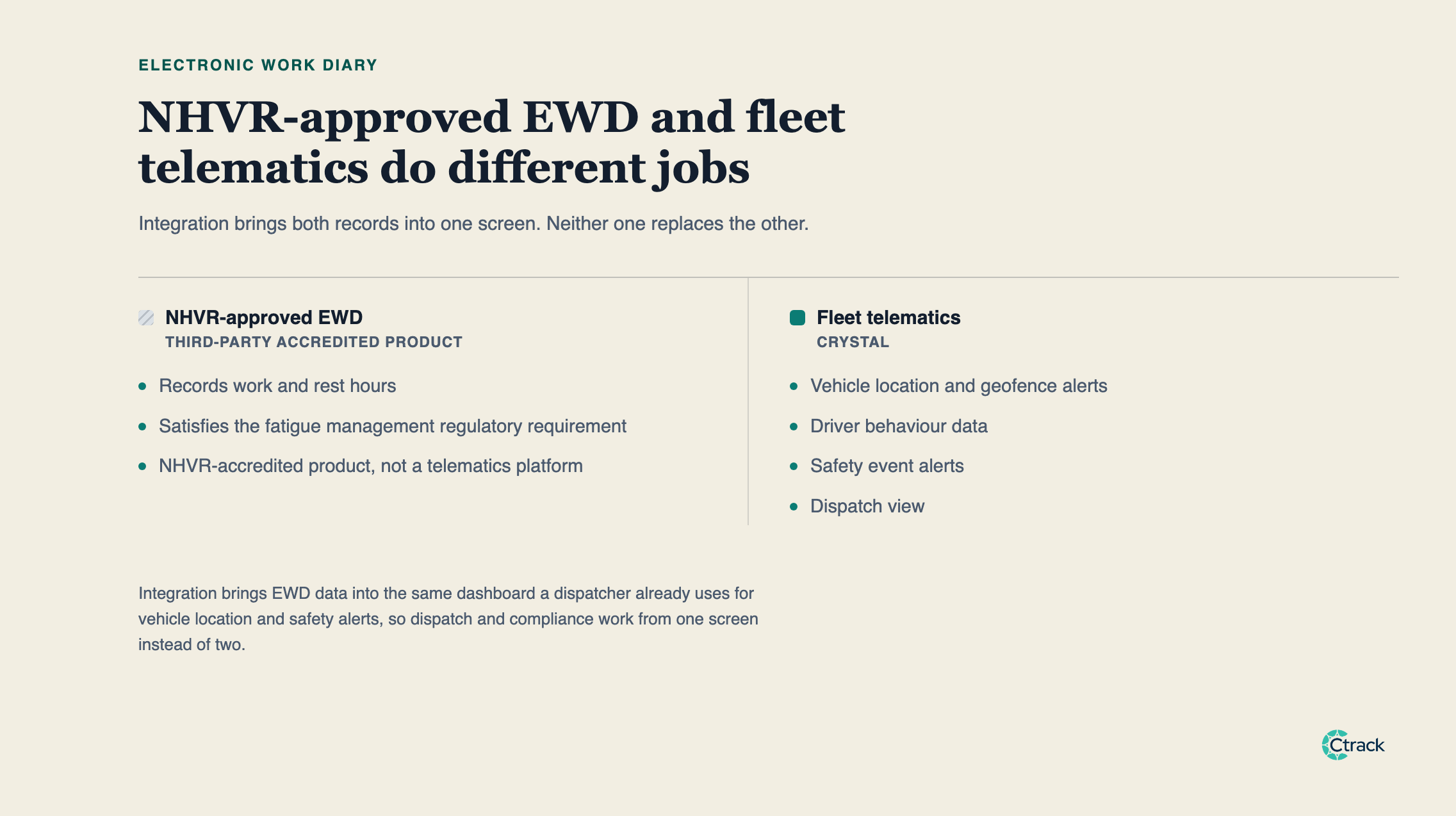
An NHVR-approved EWD does one job precisely. It satisfies the specific regulatory requirement to record a driver's work and rest hours in a format the NHVR will accept at audit. Fleet telematics does a broader job, adding vehicle location, speed, geofence alerts, driver behaviour scoring, and safety event data around that regulatory record. None of that is what the EWD itself is built to capture.
Treating these as the same system leads to two common mistakes. The first is assuming telematics alone satisfies fatigue recording obligations, which it does not. The second is running the EWD and the telematics platform as two disconnected systems. That doubles data entry and creates two separate places a dispatcher has to check before making a call about a driver's remaining hours.
NHVR compliance, accreditation and Basic Fatigue Management checks
Basic Fatigue Management accreditation carries specific record-keeping obligations, including work and rest hour limits and supporting documentation the operator must produce on request. An EWD satisfies the recording half of that obligation. The accreditation itself still requires the operator to run the broader fatigue management system the NHVR audits against. That system covers rostering practices, fitness for duty, and management oversight, not just the diary entries.
Crystal integrates with NHVR-approved EWD providers rather than positioning itself as a replacement for one. The accreditation stays with the diary product you already use.
The integration brings the accredited diary data into the same dashboard a dispatcher already uses for vehicle location and safety alerts. That closes the gap between the compliance record and day-to-day operational decisions, without asking the operator to swap out an accredited system that already works.
Why fleets connect EWD data into Crystal
Fleets connect EWD data into Crystal to solve a practical dispatch problem. A dispatcher checking whether a driver has enough hours left for a job should not need to open a second login to find out. Bringing EWD data into the same operational view as vehicle location and safety events means that check happens in one screen instead of two. Our EWD and telematics integration buyer's guide covers the questions worth asking any vendor before connecting the two.
An Electronic Work Diary also removes the paper trail risk that comes with handwritten logbooks. Records get lost or illegible, entries get made after the fact, or pages get left at a depot when a driver needs them roadside. It gives an operator a defensible, time-stamped record that stands up better under NHVR review than a paper diary reconstructed from memory.
Connected to fleet telematics, that benefit compounds. A driver carries one app for job management and work diary entries, rather than switching between a compliance tool and an operations tool that do not talk to each other. Compliance evidence and fleet operations sit in the same platform, which reduces the manual re-keying that creates errors in the first place.
What integration should deliver for dispatch and compliance
Integration between an NHVR-approved EWD and a fleet telematics platform should deliver one practical outcome. Data should flow into a single dashboard for dispatch and compliance review, without duplicate entry across separate logins. A dispatcher planning tomorrow's runs should see remaining driving hours next to vehicle location and job status, not in a separate tab they have to remember to check.
Using an EWD does not remove the operator's underlying compliance duties. The operator still needs to confirm the EWD product carries current NHVR accreditation and train drivers on correct use. The accreditation scheme also requires broader fatigue management practices around rostering and fitness for duty. Integration with a telematics platform supports these duties by surfacing the data where operations and compliance teams already work. The duties themselves remain the operator's to manage.
Where heavy vehicle EWD data fits with telematics and safety systems
EWD data is one part of a larger evidence picture that also includes fatigue alerts, pre-start checks, and video evidence where cameras are fitted. Fatigue detection as a Crystal capability tracks driving hours and rest breaks in real time, flagging an approaching breach before it happens rather than only reporting it afterward. That gives a dispatcher a chance to intervene with a schedule change, instead of discovering the breach at audit time.
This is also where Chain of Responsibility evidence connects back to EWD data. An auditor reviewing a primary-duty case looks at work diary records alongside pre-start logs and, where relevant, video evidence. Together they build a full picture of how a fleet manages fatigue risk. The Chain of Responsibility 2026 guide walks through the five evidence categories an NHVR auditor asks for first, if you are working out what to connect in which order.
Key takeaways
- NHVR accreditation sits with the EWD product itself, not with the telematics platform layered on top of it.
- Telematics alone does not satisfy fatigue recording obligations -- an approved EWD and a telematics platform do different jobs.
- Confirm a specific EWD product carries current NHVR approval before rolling it out to drivers.
- Good integration means one dashboard and one driver app, not duplicate entry across two separate logins.
- BFM accreditation still requires rostering, fitness for duty, and management oversight -- the diary is only the recording half.
Frequently asked questions
No. Crystal integrates with NHVR-approved EWD providers so fleets can bring that accredited work diary data into one operational view alongside vehicle location and safety information. It is not itself an EWD app. The NHVR accreditation sits with the EWD product a driver uses to record work and rest hours, not with the telematics platform layered around it.
Yes. An NHVR-approved EWD satisfies the specific regulatory record for driver work and rest hours under the fatigue management accreditation scheme. Fleet telematics adds vehicle location, safety event data, and operational visibility around that record. It does not replace the accredited diary or the fatigue management duties tied to that accreditation.
Integration should mean EWD data flows into the same dashboard a dispatcher and compliance officer already use for vehicle location and safety events. It should not require duplicate entry across two separate logins. A driver should be able to work from a single app, rather than switching between a compliance tool and an operations tool that were never designed to share data.
Next steps
If EWD data and fleet operations are still living in two separate logins, it is worth seeing what a connected view looks like. Book a demo to see how Crystal integrates with NHVR-approved EWD providers for dispatch and compliance in one platform.
For the full picture of what the integration covers, start with the electronic work diary solution.
This article is general information, not legal advice.