


Chain of Responsibility (CoR) is the part of the Heavy Vehicle National Law (HVNL) that spreads safety accountability across every party who influences a heavy vehicle journey. That includes the operator, the scheduler, the loader, the consignor, the consignee, and company executives, not just the driver behind the wheel.
Each party carries a primary duty to eliminate or minimise safety risk so far as reasonably practicable, as set out in NHVR's Chain of Responsibility guidance. The NHVR does not require perfection. It requires evidence that you identified the risk, took reasonable steps to manage it, and can show your work if asked.
For fleet managers and compliance officers, 2026 is the year that evidence expectation gets sharper. A reform package commences on 1 August 2026, and it changes what "reasonably practicable" looks like in an audit. Getting the paperwork and the telematics evidence aligned before that date matters more than it did twelve months ago.
What changes on 1 August 2026, and which states it applies to
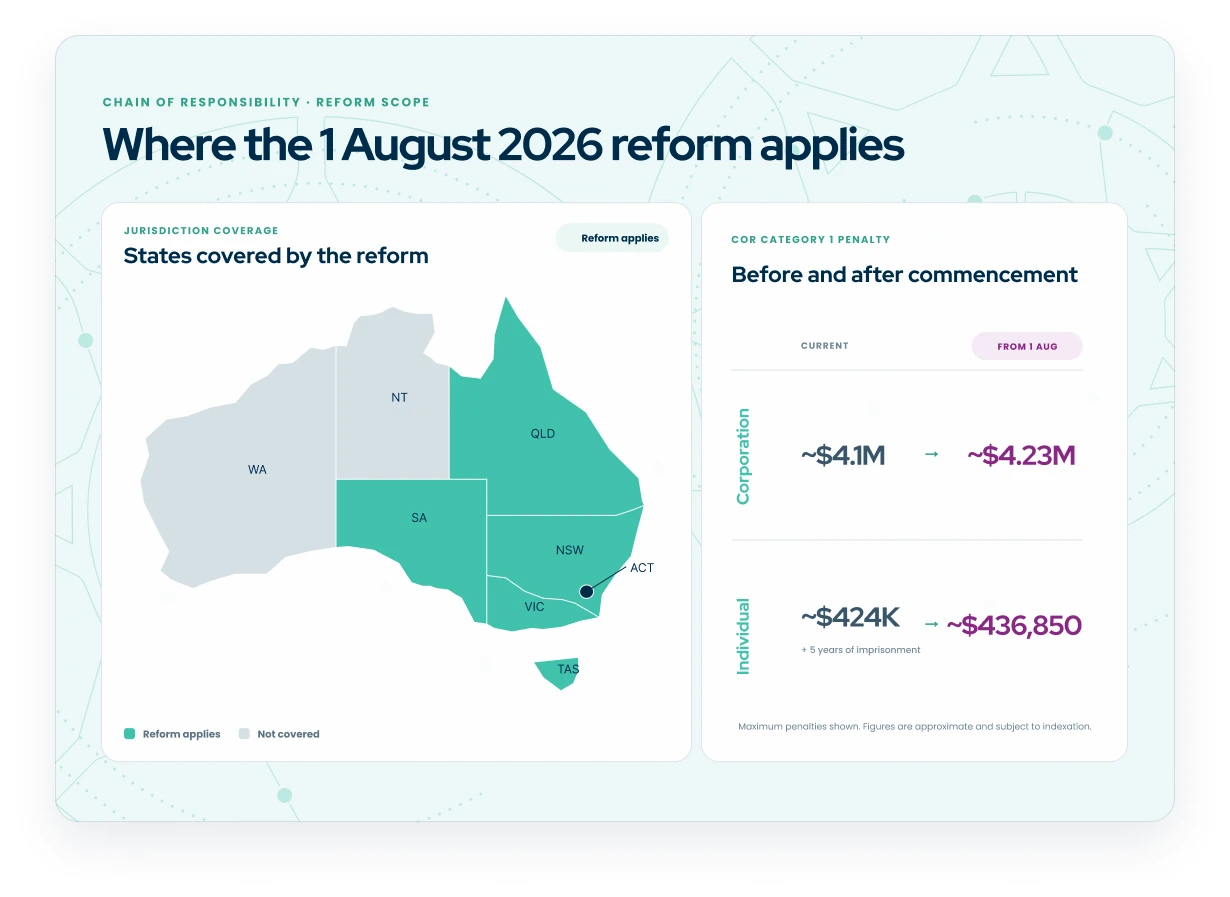
The HVNL reform commences 1 August 2026 in the Australian Capital Territory, New South Wales, Queensland, South Australia, Tasmania, and Victoria. It does not apply in Western Australia or the Northern Territory, which sit outside the national law. If your fleet runs interstate routes touching WA or NT, treat those legs under the separate state-based regime that already applies there.
Two structural changes matter most for compliance teams. First, the NHVAS Mass, Maintenance, Basic Fatigue Management and Advanced Fatigue Management modules consolidate into a General Safety Accreditation and an Alternative Compliance Accreditation. Operators accredited under the old modules need to reaccredit under the new structure, rather than assume the old paperwork rolls over automatically.
The regulated fleet also widens at the same time. The unfit-to-drive duty previously applied to heavy vehicles of 12 tonnes and above. It now extends to all heavy vehicles of 4.5 tonnes and above, pulling a materially larger slice of light-to-medium rigid fleets into scope.
Second, audit findings become admissible as evidence in primary-duty prosecutions. A clean, well-documented audit becomes a defensive asset. A poorly managed one becomes material the NHVR can use against you. This single change raises the stakes on every pre-start log, fatigue record, and evidence trail your fleet holds.
CoR Category 1, the most serious tier, carries a maximum penalty of $4,230,550 for a corporation, or $436,850 plus up to five years' imprisonment for an individual.
The penalty exposure itself is not what moves on 1 August. The NHVR indexes those figures annually under section 737 of the HVNL, and the current amounts have applied since 1 July 2026. The reform changes accreditation, the audit evidence rules, and the vehicle weight threshold, not the Category 1 figure.
Primary duty and executive due diligence in plain language
Sections 26C and 26D of the HVNL are the load-bearing provisions here, and the 2026 reform does not replace them. It strengthens the evidentiary regime around them. Section 26C sets the primary duty itself.
Section 26D sets the executive due diligence duty. It requires company officers to take reasonable steps to verify the business is managing its transport safety risks, not just documenting an intention to.
In practice, due diligence means an executive can show they allocated resources to safety, monitored whether controls were followed, and acted when gaps appeared. A safety policy sitting unread in a folder does not satisfy this duty. A dashboard showing fatigue breaches, pre-start defects, and how each was resolved goes a long way toward it.
The NHVR has already shown it will pursue individuals, not just the operator entity. N Godfrey Haulage Pty Ltd and its sole director were charged in 2020 under sections 26D, 467, and 569 of the HVNL. It was the first prosecution of its kind under the primary-duty regime. The case is a reminder that executive due diligence is a personal duty, and the 2026 reform gives regulators a sharper evidentiary tool to test it.
Evidence operators need on hand
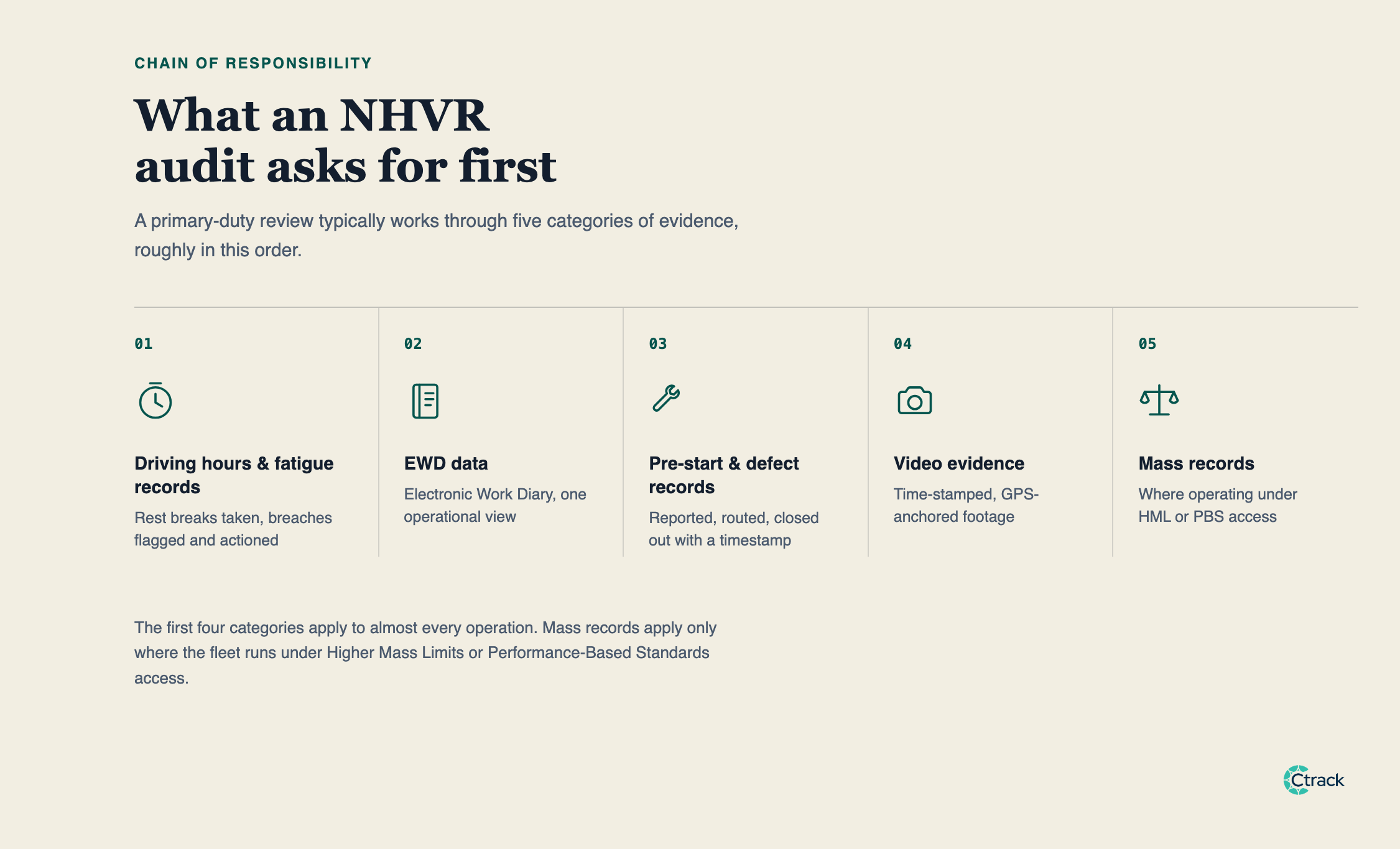
An NHVR auditor working through a primary-duty review will typically ask for five categories of evidence. Driving hours and fatigue records come first, showing rest breaks were taken and breaches were flagged and actioned, not just logged. Our HVNL primary-duty evidence checklist sets out what each category should contain in full.
Electronic Work Diary data is second. It needs to trace back to an EWD integration that pulls records from an NHVR-approved provider into one operational view. That beats sitting in a separate login nobody checks.
Pre-start and defect records are the third category. Auditors want to see that a defect was reported, routed to the workshop, and closed out, with a timestamp on each step. Video evidence is fourth. Time-stamped, GPS-anchored footage from video telematics and Crystal Vision supports a fatigue or harsh-driving investigation far better than a driver's written account after the fact.
Mass records round out the list for fleets operating under Higher Mass Limits or Performance-Based Standards for access. If your operation falls outside those schemes, this category may not apply, but the first four almost always do. Pre-start compliance itself is worth building out properly. See the pre-start checks solution for how digital defect logging closes that particular evidence gap.
How Crystal supports the evidence layer
Crystal produces the time-stamped, GPS-anchored evidence that the primary-duty audit framework is built around. Telematics data, EWD integration, fatigue alerts, and driver-behaviour records generate the safety-management-system artefacts an auditor expects to see. Each record is attributable to a specific vehicle, driver, and moment in time.
Video evidence adds the "why" that GPS alone cannot answer. Crystal Vision, Ctrack's AI video telematics module, records on an event-based basis rather than continuously. It produces a searchable evidence library indexed by driver, vehicle, event type, and severity.
That distinction matters for privacy as much as for compliance. It protects drivers rather than watching them, and the footage exists to exonerate a driver in a dispute as often as it supports a coaching conversation.
Coaching workflows add a layer auditors specifically look for: an acknowledged event, a manager sign-off, and a record of what changed afterward. That acknowledgement trail separates a fleet that ignored a fatigue alert from one that acted on it. It is exactly the kind of due diligence evidence section 26D asks an executive to be able to show.
None of this replaces your safety management system or your lawyer. Crystal is the evidence layer. You still own the SMS, the policy decisions, and the legal positioning that sits around that evidence.
A well-run Chain of Responsibility solution centralises these records, so an audit request takes minutes to answer instead of days. It pairs naturally with fatigue management if you are still mapping out what to connect first.
Key takeaways
- The HVNL reform commences 1 August 2026 in ACT, NSW, QLD, SA, TAS and VIC. WA and NT are not covered.
- NHVAS modules consolidate into General Safety Accreditation and Alternative Compliance Accreditation -- old accreditations do not roll over automatically.
- The unfit-to-drive duty extends from 12 tonnes down to all heavy vehicles of 4.5 tonnes and above.
- Audit findings become admissible in primary-duty prosecutions, so a well-run audit is a defensive asset and a poor one is evidence against you.
- Have five evidence categories ready: fatigue records, EWD data, pre-start and defect close-outs, video evidence, and mass records where applicable.
Frequently asked questions
CoR Category 1, the top penalty tier, carries a maximum penalty of $4,230,550 for a corporation. For an individual it is $436,850 plus up to five years' imprisonment. These figures are indexed annually by the NHVR under section 737 of the HVNL and have applied since 1 July 2026. The 1 August 2026 reform changes accreditation, audit evidence rules, and the vehicle weight threshold rather than this penalty figure. Older numbers such as $3 million or $3.55 million are outdated and should not be quoted.
The reform commences 1 August 2026 in the Australian Capital Territory, New South Wales, Queensland, South Australia, Tasmania, and Victoria. Western Australia and the Northern Territory are not part of the Heavy Vehicle National Law and are not covered by this reform. Fleets operating across state lines need to track which jurisdiction applies to each leg of a journey.
No single system delivers compliance on its own. A GPS and video telematics platform provides the evidence layer that supports your safety management system, showing driving hours, fatigue events, pre-start outcomes, and incident footage in one place. It does not replace legal advice, and it does not substitute for the safety management system your business is required to run and demonstrate.
Next steps
The 1 August 2026 reform raises the cost of a disorganised evidence trail. Before that date lands, walk through what an auditor would ask for and confirm you can produce it inside minutes, not days.
Book a demo to see how Crystal brings driving hours, EWD data, pre-start records, and video evidence into a single Chain of Responsibility view.
This article is general information, not legal advice.