

Aviation Fleet Management NZ
Crystal gives NZ airports and airlines real-time visibility across every ground support vehicle. Track airside movements, enforce zone authorisation, and build audit-ready records for CAA Part 139 and WorkSafe NZ.
Trusted by leading New Zealand fleets




40+ years
Fleet management experience
300,000+
Subscriptions worldwide
NZ support
Local team and installation
NZ$1,180
Daily downtime cost
Vehicle downtime at NZ airports costs between NZ$1,000 and NZ$1,180 per vehicle per day during critical operational windows
30%
Downtime reduction
Telematics reduces unplanned downtime events by up to 30%, keeping ground support vehicles operational when it matters most
10-15%
Fuel savings
Route optimisation and driver behaviour monitoring cut fuel costs by 10-15% across tracked aviation ground fleets
5-10 hrs
Weekly admin saved
Fleet managers recover 5-10 hours per week by replacing manual records with automated fleet analytics and reporting
FLEET TRACKING
Ground Support Vehicle Tracking at New Zealand Airports
Auckland Airport manages more than 50 ground handling companies and their vehicle fleets. Wellington and Christchurch operate at smaller scale but with equally precise airside control requirements. GPS fleet tracking gives airport operators and ground handlers real-time visibility across their entire vehicle inventory.
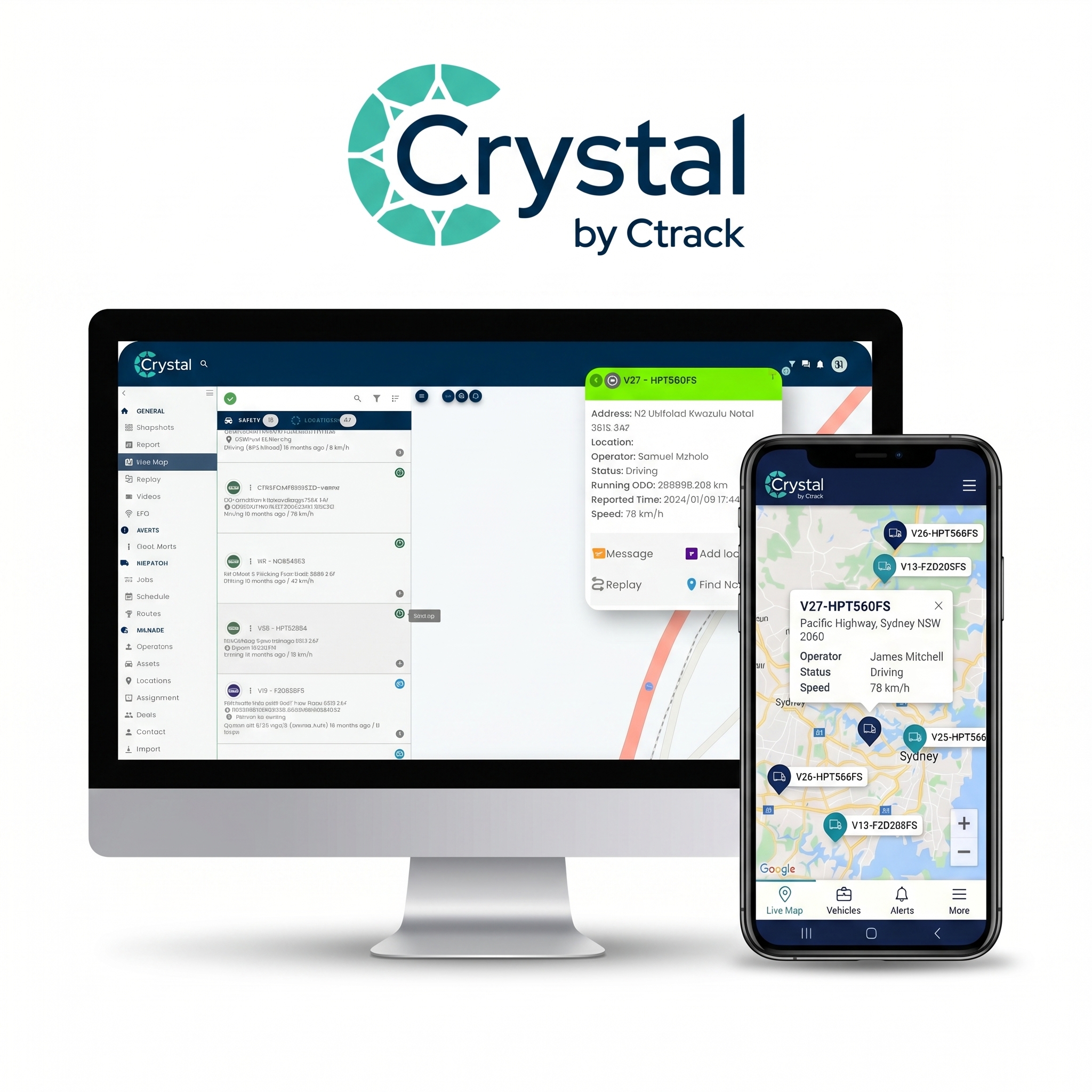
Crystal's tracking platform updates location every 10 to 60 seconds. You see where each vehicle is, whether it is in an authorised zone, and how long it has been stationary. When a vehicle appears in a restricted movement area without authorisation, you know immediately.
Fleet tracking replaces the paper trail with an automated, timestamped record. Every vehicle movement is logged. Every zone entry and exit is recorded. That data is searchable, reportable, and audit-ready the moment you need it for a CAA inspection or WorkSafe NZ review.
- Real-time vehicle location10 to 60 second GPS updates across the aerodrome. Every vehicle visible on one live map, from baggage tractors to fuel trucks.
- Zone authorisation monitoringInstant alerts when a vehicle appears in a restricted area without clearance. Supervisors receive a notification the moment it occurs.
- Audit-ready movement recordsTimestamped log of every vehicle movement, zone entry, and exit. Searchable and reportable without manual compilation.
AIRSIDE COMPLIANCE
Airside Compliance and Fleet Safety Under CAA Part 139
New Zealand's Civil Aviation Authority Part 139 sets requirements for aerodrome certification and management, including how airside vehicles and their operators are controlled within aerodrome movement areas. Every vehicle accessing the airside zone requires a valid permit. Every driver requires formal induction and airside driver authorisation.
Under HSWA, ground handling businesses and airport operators are PCBUs with a duty to identify and manage workplace transport risks. On an active apron, those risks include vehicle-aircraft collisions, pedestrian-vehicle incidents, and unauthorised access to movement areas.
Compliance monitoring through Crystal logs driver-specific activity, vehicle authorisation status, and zone access history. When an incident occurs, you have a verified record of exactly what happened, where each vehicle was, and what speed it was travelling. That record matters for incident investigation and for demonstrating due diligence to WorkSafe NZ.
- Driver-specific activity logsEvery movement linked to a driver ID. Zone access history and authorisation status recorded automatically for CAA Part 139 audits.
- Fatigue and driving hours monitoringNZTA work time rules apply to landside vehicles above 3.5 tonnes GVM. Crystal tracks driving hours and alerts supervisors before a driver approaches a breach.
- Real-time zone breach alertsSupervisors receive an alert the moment a vehicle approaches a boundary it is not cleared to cross. Rapid response without continuous monitoring.

HSWA OBLIGATIONS
Aviation PCBUs Face Up to $3 Million in HSWA Penalties
Ground operations at New Zealand airports rank among the highest-risk vehicle environments under HSWA. Penalties for reckless conduct causing serious harm or death reach $3 million for corporations and $300,000 plus five years imprisonment for individuals under Category 1 offences. Crystal gives airport operators and ground handlers a live, timestamped record of every vehicle movement across the aerodrome. That documented record is concrete evidence of a managed system when WorkSafe NZ asks how you control vehicle movement risks on your apron.
ASSET TRACKING
Asset Tracking for Airport Ground Equipment
Not all airport ground equipment has an engine. Passenger boarding stairs, ground power units, baggage dollies, and service carts move around the apron without GPS as standard. This equipment gets misplaced, borrowed by other handlers, or left in the wrong zone at the end of a shift.
Battery-powered GPS asset trackers attach to non-powered equipment alongside your vehicle fleet. Devices run for up to 10 years without a wired power connection. You see where equipment is, how long it has been stationary, and whether it has moved from its assigned location.
For ground handling operations managing equipment owned by multiple airlines, asset tracking clarifies ownership and usage disputes. You have a timestamped record of which organisation had which piece of equipment, when it was moved, and where it went. Plant and equipment without GPS tracking has a recovery rate of around 40%. GPS-tracked equipment recovers at 69% or higher.
- 10-year battery life trackersNo wired connection required. Attach to boarding stairs, ground power units, baggage dollies, and service carts across the apron.
- Equipment location before departureWhen boarding stairs go missing before a scheduled departure, find them in seconds rather than conducting a manual search across the apron.
- Ownership and usage audit trailTimestamped record of which organisation had which equipment, when it was moved, and where it went. Resolve disputes with verified data.

FLEET REPORTING
Fleet Reporting for Aviation Ground Operations
Ground handling contracts often include service level requirements around on-time performance, equipment availability, and fleet utilisation. Proving performance against those commitments historically required manual data collection and after-the-fact reporting.
Crystal fleet reporting generates automated reports on vehicle utilisation, movement history, idle time, and maintenance compliance. Reports run on a schedule and arrive in inboxes without a fleet manager needing to compile them.
For airlines with ground fleets at multiple airports, consolidated reporting shows performance across all sites in a single view. A Sounds Air or Air Chathams operations manager can compare ground vehicle utilisation at Nelson, Picton, and Wellington from one dashboard, without switching between systems. Fleet managers recover 5-10 hours per week by replacing manual records with automated analytics.
- Automated scheduled reportsReports on vehicle utilisation, idle time, and maintenance compliance delivered on a schedule. No manual compilation required.
- Multi-airport consolidated viewCompare ground fleet performance across Auckland, Wellington, Christchurch, or regional ports in one dashboard, without switching between systems.
- RUC licence managementAccurate distance data for Road User Charges on diesel vehicles above 3.5 tonnes GVM on NZ roads. Reduce the risk of RUC infringement.
See Crystal Working Across Your Aviation Ground Fleet
Live tracking, airside geofencing, asset tracking, and compliance records in one platform.
AIRSIDE GEOFENCING
Geofencing for Airside and Landside Zones
Airport operational zones are defined and regulated. The aerodrome movement area, the apron, the security-restricted zones, and the public landside areas each carry different access requirements. Crystal lets you define virtual boundaries around any operational zone and configure alerts for entry and exit events.
When a landside vehicle approaches the airside perimeter without authorisation, a supervisor receives an immediate notification. When a ground support vehicle stays in a restricted area beyond its cleared window, the system flags it automatically. Zone alerts work across mobile and email channels. At a busy airport, supervisors cannot watch a live map continuously. The system pushes the exception to them the moment it occurs.
Fuel is a significant cost in 24-hour airport ground operations. Non-productive idling wastes approximately 7% of total fuel consumption. For a mid-sized ground handling fleet of 40 vehicles spending NZ$7,000 per vehicle annually on fuel, that represents NZ$19,600 in avoidable waste. Driver behaviour monitoring and route analytics reduce fuel burn by 10-15% without any reduction in service capability.
- Configurable airside zone boundariesDefine perimeters around movement areas, restricted zones, and apron positions. Receive an alert the moment a vehicle breaches a boundary.
- Mobile and email zone alertsExceptions pushed directly to a supervisor the moment they occur. No need for continuous map monitoring at a busy terminal.
- Fuel and idle cost reductionIdentify which vehicles idle longest and where. Recover NZ$19,600 or more in avoidable fuel costs annually for a 40-vehicle ground fleet.

Aviation Fleet Management Questions
Practical answers for airport operators, ground handlers, and airlines evaluating GPS tracking and fleet management systems for their New Zealand operations.
Book an aviation fleet tracking demo
See how Crystal maps live tracking, airside geofencing, and compliance records to your airport ground operations.
What the demo covers
- See real-time tracking applied to your aerodrome and ground fleet
- Review hardware options for powered and non-powered airport equipment
- Get a tailored quote for your aviation fleet